

Study finds disruptive fintech and Belt and Road spillovers shape green development, with regional differences
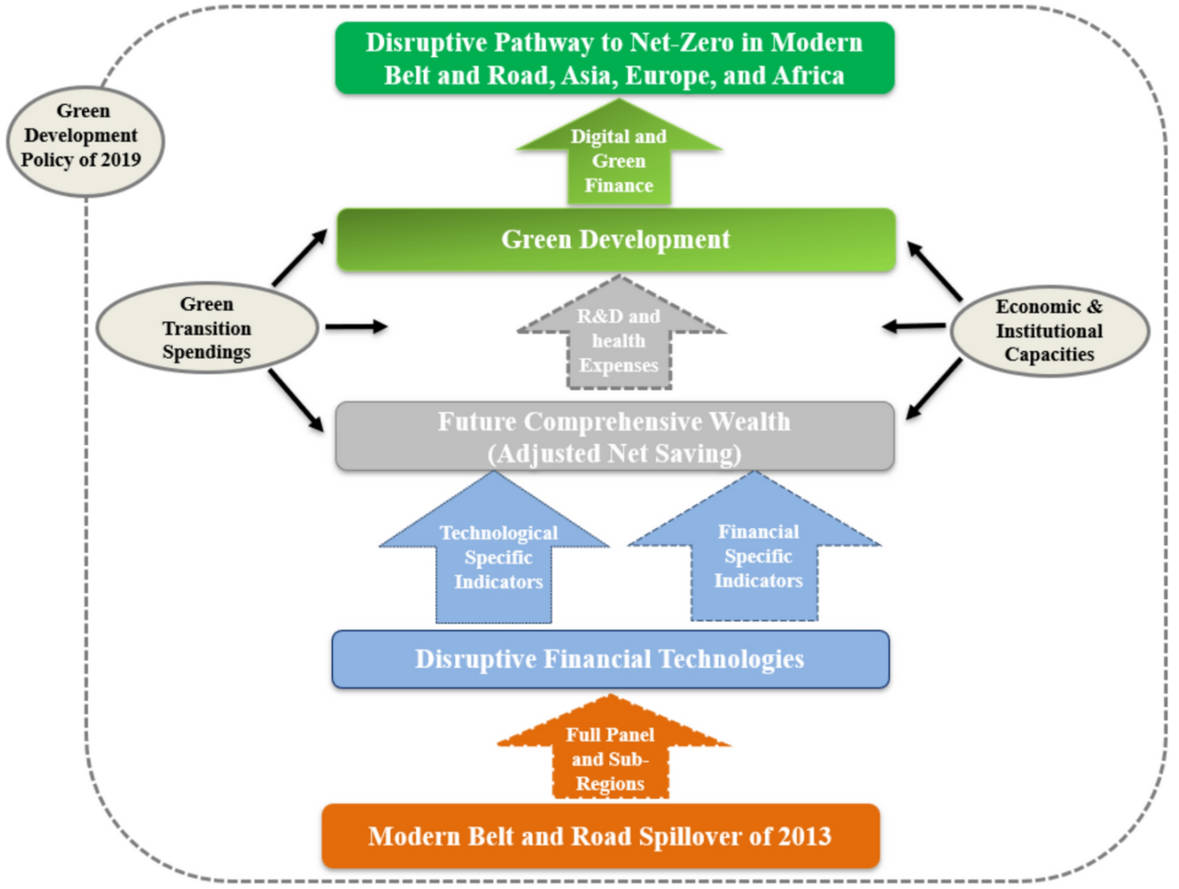
Framework for green development mechanism
GA, UNITED STATES, September 29, 2026 /EINPresswire.com/ -- New research examines whether disruptive financial technology (DFT) and modern Belt and Road (MBR) spillovers are associated with green development (GD) and net-zero pathways across 148 Belt and Road economies from 2004 to 2023. Using advanced panel econometric methods, the study finds that DFT and MBR spillovers generally show positive associations with GD, while their interaction is positive for the full panel and Europe but negative for Asia and Africa. The results suggest that the green benefits of digital finance depend on regulatory frameworks, digital readiness and project governance.
Climate change is intensifying pressure on economies to decouple growth from carbon emissions, and green development has become a strategic response. Digital payments, artificial intelligence (AI), blockchain and mobile banking are transforming finance, while the Belt and Road Initiative (BRI), launched in 2013, has expanded infrastructure, trade and investment links across Asia, Europe and Africa. Yet many Belt and Road economies still face weak regulatory frameworks, limited financial literacy, infrastructure gaps and low bank-account access, raising questions about whether fintech automatically delivers greener growth. These challenges point to a need for systematic research into how disruptive financial technology (DFT) and MBR spillovers can be aligned with green development (GD) across Asia, Europe and Africa.
The study was led by researchers from the Huazhong University of Science and Technology (HUST) in Wuhan, China, with collaborators from Wenhua College, and was published in Financial Innovation on 14 May 2026 (DOI: 10.1186/s40854-026-00931-y). It analyzes 148 Belt and Road economies from 2004 to 2023, with regional panels for Asia (49 economies), Africa (49 economies) and a Europe panel (50 economies, including Latin America and the Caribbean). The team used linear and nonlinear two-step system generalized method of moments (GMM) models, Bayesian regression, panel cointegration tests and principal component analysis (PCA)-based indices for DFT and GD. MBR spillover was measured as a dummy variable distinguishing the pre-2013 and post-2013 periods.
The results show that DFT had a positive direct association with GD across the full Belt and Road panel (β = 0.014, p = 0.05), Asia (β = 0.034, p = 0.01) and Africa (β = 0.041, p = 0.05). In Europe, the direct DFT coefficient was not statistically significant, suggesting that mature but uneven digital markets, regulatory fragmentation and cross-border integration barriers may complicate fintech's green payoff. MBR spillovers were positive for GD in the full sample (β = 0.020, p = 0.05), Asia (β = 0.061, p = 0.01), Europe (β = 0.048, p = 0.01) and Africa (β = 0.041, p = 0.01). The DFT–MBR interaction was positive for the full panel (β = 0.014, p = 0.05) and Europe (β = 0.007, p = 0.05), but negative for Asia (β = −0.044, p = 0.05) and Africa (β = −0.045, p = 0.1).
In the full panel, the business environment, government stability and the Belt and Road Initiative Green Development Coalition (BRIGC) were negatively associated with GD, while credit union deposits (CUD) were positive. Renewable energy transition (RET) was positive but not statistically significant in the full panel. Regional results varied: for example, government stability and RET were positive in Asia, while CUD and BRIGC were positive in Africa. These mixed patterns suggest that the effects of digital finance and Belt and Road spillovers depend on regional institutional and economic contexts.
The study concludes that fintech is not automatically green. Its impact depends on regulation, digital readiness, financial literacy and how Belt and Road projects are governed. The findings suggest that Asia and Africa may require stronger environmental compliance, cross-border project governance and tech-driven green investment, while Europe and the full panel show how fintech can work with Belt and Road spillovers when markets and rules are more mature. Without these conditions, faster digital finance may not translate into greener growth.
The findings have implications for policymakers, regulators and financial institutions. The study suggests that Belt and Road economies may consider aligning digital finance policies with environmental standards, strengthening regulatory frameworks, and expanding financial and digital literacy. Green bonds, sustainability-linked loans, carbon trading platforms and environmental taxes could channel capital toward low-carbon projects, while government stability and a better business environment may help reduce policy uncertainty. Regional cooperation could prioritize renewable energy, technology transfer and green lending, particularly in Asia and Africa. The authors situate these implications in the context of COP29 discussions, the 2030 Sustainable Development Goals (SDGs) and long-term net-zero pathways.
The study also notes limitations. The DFT index may not fully capture the complexity of the Belt and Road Initiative, and future research could examine how the relationship between DFT and GD varies across income groups and governance frameworks.
References
DOI
10.1186/s40854-026-00931-y
Original Source URL
https://doi.org/10.1186/s40854-026-00931-y
Funding information
This work was supported by Smart Grid-National Science and Technology Major Project (2024ZD0800500) and Fundamental Research Funds for Central Universities (2024WKYXQN016).
Lucy Wang
BioDesign Research
email us here
Legal Disclaimer:
EIN Presswire provides this news content "as is" without warranty of any kind. We do not accept any responsibility or liability for the accuracy, content, images, videos, licenses, completeness, legality, or reliability of the information contained in this article. If you have any complaints or copyright issues related to this article, kindly contact the author above.
