

Furniture Market to Grow Toward USD 1,300.79 Billion by 2035 with Increasing Demand for Premium Furniture Solutions
Furniture Market
Furniture Market is expanding with rising demand for functional designs, sustainable materials, premium solutions, innovative products for residential sectors.
NEW YORK, NY, UNITED STATES, July 13, 2026 /EINPresswire.com/ -- Market Overview:The global Furniture Market Demand is witnessing significant transformation as changing lifestyles, evolving workplace environments, urban expansion, and increasing consumer preferences for aesthetically appealing interiors continue to influence purchasing decisions. Furniture has become more than a basic household requirement, with consumers and businesses increasingly focusing on comfort, functionality, durability, design innovation, and sustainability. From residential homes to corporate offices, hospitality spaces, educational institutions, and commercial establishments, furniture solutions play an essential role in enhancing living and working environments.
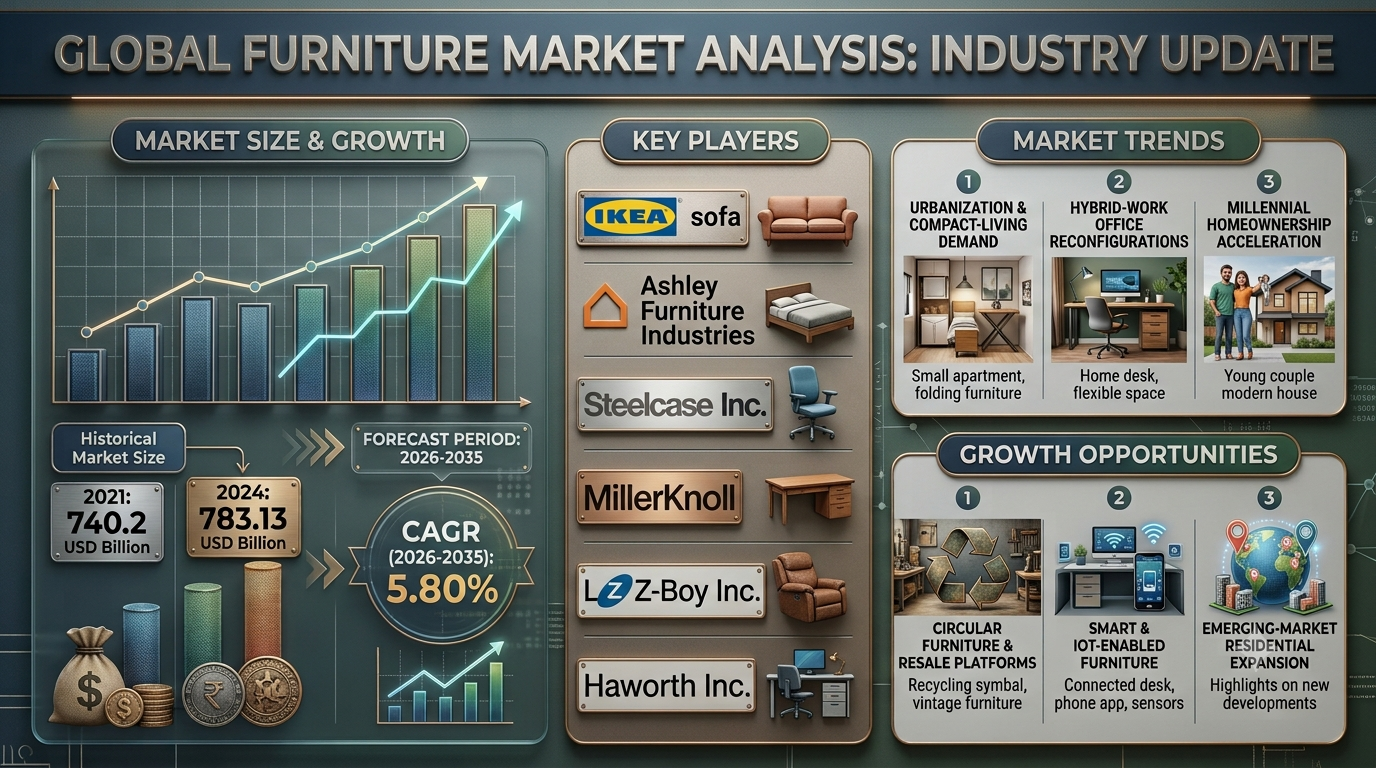
According to Market Research Future analysis, the Furniture Market was valued at USD 740.20 Billion in 2025 and is projected to reach USD 1,300.79 Billion by 2035, expanding at a CAGR of 5.80% during the forecast period of 2026–2035. The market growth is supported by increasing construction activities, rising disposable income, growing urban populations, and the continuous demand for modern furniture designs that align with changing consumer expectations.
Furniture Market Growth Drivers:
Increasing Urbanization and Residential Development Supporting Market Expansion
Rapid urbanization across various regions has become one of the major factors influencing furniture demand. As more people move toward urban areas, the need for residential spaces, apartments, and modern housing solutions continues to increase. New homeowners and tenants are investing in furniture products that improve space utilization while offering enhanced comfort and visual appeal.
The expansion of real estate development projects, including residential complexes and smart housing initiatives, is creating new opportunities for furniture manufacturers. Modern consumers are increasingly interested in modular furniture, multifunctional designs, and space-saving solutions, particularly in urban locations where living spaces are becoming more compact.
Home renovation and interior improvement activities are also contributing to market growth. Consumers are upgrading their living spaces with contemporary furniture designs that reflect personal preferences and lifestyle choices. The growing influence of interior design trends through digital platforms has further encouraged customers to explore new furniture styles and premium-quality products.
Rising Demand for Workplace Furniture and Flexible Office Solutions:
The evolution of workplace environments has significantly impacted the demand for commercial furniture. Businesses are increasingly focusing on creating productive, comfortable, and collaborative office spaces that support employee well-being and operational efficiency. This has increased the adoption of ergonomic chairs, adjustable desks, modular workstations, and flexible office furniture systems.
The growth of hybrid work models has further changed office furniture requirements. Companies are redesigning workplaces to support collaboration, creativity, and employee interaction rather than relying only on traditional desk-based layouts. This trend has increased demand for adaptable furniture solutions that can be easily rearranged according to changing workplace needs.
Among different application categories, office furniture is expected to represent one of the fastest-growing segments due to rising investments in workplace infrastructure and changing corporate design preferences. Organizations are increasingly considering furniture as an important element of workplace branding and employee satisfaction.
Growing Consumer Preference for Premium and Customized Furniture:
Consumer purchasing behavior within the furniture industry is gradually shifting toward premium and customized products. Customers are showing greater interest in furniture pieces that provide superior quality, unique designs, long-term durability, and enhanced functionality.
Premium furniture products are gaining attention among consumers who prioritize luxury interiors and personalized home environments. Increasing disposable income levels and changing lifestyle preferences are encouraging customers to invest in high-quality furniture rather than focusing only on affordability.
Customization has also emerged as an important trend within the industry. Consumers are looking for furniture designs that match specific room dimensions, color preferences, and functional requirements. Manufacturers are responding by offering personalized options, innovative designs, and flexible product configurations.
The rise of online furniture platforms has further supported this trend by allowing consumers to explore a wider range of designs, compare options, and access customized solutions from different manufacturers. Digital transformation within furniture retail is improving customer accessibility and expanding market reach.
Download Free Sample PDF Copy : – Access A Complimentary Copy of Our Report to Explore Its Content and Insights
https://www.marketresearchfuture.com/sample_request/7625
Impact of Sustainability Trends on the Furniture Industry:
Sustainability has become a major consideration for both manufacturers and consumers in the furniture sector. Growing awareness regarding environmental protection and responsible consumption has encouraged companies to adopt sustainable materials, eco-friendly production methods, and recyclable furniture solutions.
Consumers are increasingly interested in furniture made from responsibly sourced materials and products designed with longer lifespans. Manufacturers are focusing on reducing waste, improving resource efficiency, and developing environmentally conscious product lines to meet changing expectations.
The adoption of sustainable practices is also influencing product innovation. Companies are exploring alternative materials, improved manufacturing processes, and circular economy approaches to minimize environmental impact. This focus on sustainability is expected to create new opportunities for furniture companies while strengthening consumer trust.
Furniture Market Segment Analysis:
▪️Segmentation Based on Material
The Furniture Market is segmented into wood, metal, plastic, glass, and other materials. Each material type offers different benefits and meets various residential and commercial furniture needs.
▪️Metal Furniture Segment
The metal furniture segment is expected to grow due to its durability, strength, modern design, and low maintenance requirements. Metal furniture is widely used in offices, commercial spaces, and industrial environments. Growing demand for contemporary interiors and durable furniture solutions is supporting segment growth.
▪️Wood Furniture Segment
Wood furniture remains a popular choice due to its natural appearance, durability, and timeless appeal. It is commonly used in homes for living rooms, bedrooms, dining areas, and offices. The adoption of sustainable wood practices and modern designs is further supporting the growth of this segment.
▪️Segmentation Based on Application
The Furniture Market is segmented into residential, commercial, hospitality, educational, and institutional applications. Each segment contributes to market growth by meeting different requirements related to comfort, functionality, and design.
▪️Residential Furniture Segment
The residential segment holds a significant share due to rising housing development, home renovation activities, and changing consumer preferences. Growing demand for stylish, compact, and multifunctional furniture is encouraging manufacturers to introduce innovative designs. Online furniture platforms are also improving accessibility and influencing buying behavior.
▪️Commercial Furniture Segment
The commercial segment is expanding due to increasing office development and workplace modernization. Demand for ergonomic chairs, modular workstations, and customized office furniture is rising as businesses focus on employee comfort and productivity.
▪️Hospitality and Institutional Furniture Segment
The hospitality segment benefits from growth in hotels, resorts, and restaurants, where durable and attractive furniture enhances customer experiences. Educational and institutional sectors are also driving demand for practical and long-lasting furniture solutions for schools, universities, healthcare facilities, and public spaces.
▪️Segmentation Based on Price Range
The Furniture Market is divided into premium, mid-range, and economy segments.
▪️Premium Furniture Segment
Premium furniture is gaining popularity due to increasing demand for luxury interiors, customized designs, and high-quality materials. Consumers and businesses are seeking products that offer style, durability, and unique designs.
▪️Mid-Range and Economy Furniture Segment
Mid-range furniture attracts consumers looking for a balance between affordability and quality, while economy furniture serves price-sensitive customers seeking functional and cost-effective solutions. Growth in urban households and emerging markets continues to support these segments.
Regional Analysis of the Furniture Market:
The global Furniture Market shows varied growth trends across regions due to differences in economic development, consumer preferences, construction activities, and lifestyle changes.
North America
North America is a well-established furniture market supported by residential demand, commercial development, and rising home improvement activities. Increasing interest in sustainable materials, smart furniture, and ergonomic home office solutions is influencing regional growth. The expansion of remote and hybrid work trends is also boosting demand for residential and office furniture.
Europe
Europe continues to witness steady market growth driven by strong demand for quality, sustainable, and innovative furniture designs. Consumers are increasingly adopting minimalist styles, multifunctional furniture, and eco-friendly products. Manufacturers are focusing on sustainable materials and efficient production methods to meet changing preferences.
Asia-Pacific
Asia-Pacific offers significant growth opportunities due to rapid urbanization, rising incomes, expanding residential construction, and commercial development. Growing e-commerce adoption and changing lifestyles are increasing demand for modern and affordable furniture solutions across the region.
Middle East, Africa, and Latin America
These emerging regions are experiencing rising furniture demand due to infrastructure development, hospitality expansion, and urban growth. Increasing residential and commercial projects are creating new opportunities for furniture manufacturers to expand their presence in these markets.
Competitive Landscape of the Furniture Market:
The Furniture Market features established manufacturers and innovative companies competing through product development, sustainability, brand expansion, and customer-focused strategies. Companies are enhancing their product portfolios with functional, durable, and stylish furniture solutions for residential, commercial, hospitality, and institutional applications.
Market players are investing in customized designs, modular furniture, advanced manufacturing technologies, and digital platforms to improve customer experiences. The growth of online furniture sales, virtual visualization tools, and e-commerce solutions is helping companies expand their reach.
Key Companies Profiled in the Furniture Market:
▪️IKEA
▪️Ashley Furniture
▪️Steelcase
▪️MillerKnoll
▪️La-Z-Boy
▪️Haworth
▪️HNI Corp.
▪️Williams-Sonoma
▪️Hooker Furnishings
▪️Ethan Allen
These companies are involved in designing, manufacturing, and distributing furniture products across multiple applications, including residential, office, hospitality, and institutional sectors.
Leading furniture companies are focusing on product innovation, customer experience enhancement, and market expansion strategies to address evolving demand patterns. The integration of modern designs, sustainable materials, and technology-enabled solutions is becoming increasingly important for maintaining competitiveness.
Key Opportunities in the Furniture Market:
Expansion of Online Furniture Retail
The growth of e-commerce platforms represents a major opportunity for furniture companies. Online channels are transforming the traditional furniture purchasing experience by allowing consumers to explore extensive product collections, compare designs, and access customized solutions from their homes.
Digital platforms are helping manufacturers expand their customer reach beyond traditional physical stores. Advanced technologies such as virtual room visualization and digital design tools are improving consumer confidence by allowing buyers to understand how furniture products will appear in their spaces before making purchasing decisions.
The increasing adoption of online shopping among younger consumers is expected to create additional opportunities for furniture brands to strengthen their digital presence.
Rising Demand for Smart and Multifunctional Furniture:
The growing adoption of smart homes and connected living environments is creating opportunities for furniture manufacturers to introduce technology-integrated products. Consumers are increasingly interested in furniture solutions that provide additional convenience and functionality.
Smart furniture concepts, including adjustable workstations, space-saving designs, and technology-compatible furniture, are gaining attention among modern households and businesses.
The increasing need for efficient space utilization, especially in urban areas, is encouraging manufacturers to develop multifunctional furniture products that serve multiple purposes.
Increasing Focus on Sustainable Furniture Solutions
Sustainability continues to create new opportunities within the furniture industry. Consumers are becoming more conscious about environmental impacts and are seeking products made using responsible materials and ethical manufacturing practices.
Companies investing in sustainable production methods, recyclable materials, and environmentally friendly designs are expected to gain stronger consumer acceptance. The shift toward sustainable furniture is encouraging innovation throughout the supply chain, from material sourcing to manufacturing and distribution.
Challenges Affecting Furniture Market Growth:
Fluctuating Raw Material Costs
One of the major challenges affecting the furniture industry is the variation in raw material prices. Materials such as wood, metal, and other manufacturing inputs influence production costs and overall pricing strategies.
Changes in supply availability, transportation expenses, and economic conditions can impact manufacturing operations. Companies need to adopt efficient supply chain management strategies to maintain competitiveness while managing cost pressures.
Supply Chain and Manufacturing Complexities
The furniture industry involves multiple stages, including material sourcing, production, transportation, and distribution. Disruptions at any stage can affect product availability and delivery timelines.
Manufacturers are focusing on improving supply chain flexibility and adopting advanced technologies to enhance operational efficiency. Building resilient supply networks has become increasingly important for maintaining consistent product delivery.
Changing Consumer Preferences
Consumer expectations within the furniture industry are continuously evolving. Customers are increasingly demanding products that offer better designs, customization options, sustainability benefits, and competitive pricing.
Manufacturers need to continuously innovate and adapt to changing market trends. Companies that fail to respond to shifting preferences may face challenges in maintaining customer engagement and market relevance.
Future Outlook of the Furniture Market:
The global Furniture Market is expected to experience sustained growth through 2035 as consumer lifestyles, business environments, and infrastructure development continue to evolve. The increasing demand for functional, attractive, and sustainable furniture solutions will remain a major factor influencing industry expansion.
The market is projected to grow from USD 740.20 Billion in 2025 to USD 1,300.79 Billion by 2035, registering a CAGR of 5.80% between 2026 and 2035. Future growth will be supported by residential development, workplace transformation, hospitality expansion, and increasing investments in premium furniture solutions.
Innovation will continue to play an important role in shaping the future of the industry. Manufacturers are expected to focus on smart furniture, sustainable materials, modular designs, and customized solutions to meet changing customer expectations.
The office furniture segment is likely to benefit from continued workplace evolution, while the metal furniture segment is expected to gain momentum due to its durability and modern design applications. Premium furniture demand will continue to rise as consumers seek personalized and high-quality interior solutions.
Frequently Asked Questions?
1. What is the projected size of the Furniture Market by 2035?
The global Furniture Market is projected to reach USD 1,300.79 Billion by 2035, growing from USD 740.20 Billion in 2025 at a CAGR of 5.80% during 2026–2035.
2. Which segment is expected to grow fastest in the Furniture Market?
The metal furniture segment by material, office furniture segment by application, and premium furniture segment by price range are expected to experience strong growth during the forecast period.
3. What factors are driving the growth of the Furniture Market?
Key growth factors include increasing urbanization, residential construction, workplace modernization, rising demand for sustainable products, growth of online furniture retail, and increasing consumer preference for premium and customized designs.
4. Who are the major companies operating in the Furniture Market?
Major companies profiled in the Furniture Market include IKEA, Ashley Furniture, Steelcase, MillerKnoll, La-Z-Boy, Haworth, HNI Corp., Williams-Sonoma, Hooker Furnishings, and Ethan Allen.
Read Our Related Research Report:
Fabric Stain Remover Market:
https://www.marketresearchfuture.com/reports/fabric-stain-remover-market-33268
Home Accessorie Market:
https://www.marketresearchfuture.com/reports/home-accessorie-market-33350
Home Care Service Market:
https://www.marketresearchfuture.com/reports/home-care-service-market-33384
Home Rehabilitation Product Market:
https://www.marketresearchfuture.com/reports/home-rehabilitation-product-market-33772
Household Cleaner Market:
https://www.marketresearchfuture.com/reports/household-cleaner-market-33829
Sagar Kadam
Market Research Future
+1 628-258-0071
email us here
Legal Disclaimer:
EIN Presswire provides this news content "as is" without warranty of any kind. We do not accept any responsibility or liability for the accuracy, content, images, videos, licenses, completeness, legality, or reliability of the information contained in this article. If you have any complaints or copyright issues related to this article, kindly contact the author above.
