

[Latest] Waterborne Epoxy Resins Market to Grow Rapidly, Hitting US$ 8.51 Billion by 2034 at a 6.03% CAGR, stringently enforced international laws targeting environmental VOC reduction, says ZMR
NEW YORK, USA, July 06, 2026 (GLOBE NEWSWIRE) -- Zion Market Research has published a new research report titled “Waterborne Epoxy Resins Market By Product Type (Solid Epoxy Resins, Liquid Epoxy Resins, Waterborne Epoxy Emulsions, Waterborne Epoxy Hardeners), By Application (Paints and Coatings, Adhesives and Sealants, Flooring Systems, Composites and Structural Applications), By End-User (Construction and Infrastructure Sector, Automotive and Transportation Manufacturers, Marine and Protective Coating Applicators, Electronics and Electrical Industry), By Distribution Channel (Direct Sales to Manufacturers, Chemical Distributors, Specialty Coating Suppliers, Online Chemical Platforms), and By Region - Global and Regional Industry Overview, Market Intelligence, Comprehensive Analysis, Historical Data, and Forecasts 2025 - 2034” in its research database.
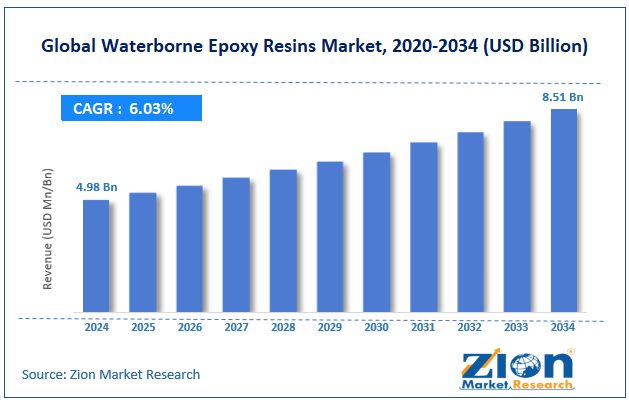
“According to the latest research study, the global waterborne epoxy resins market size was valued at around USD 4.98 billion in 2024. The market is expected to grow at a CAGR of 6.03% and is anticipated to reach a value of USD 8.51 billion by 2034.”
Get a Free Sample PDF of this Research Report for more Insights - https://www.zionmarketresearch.com/sample/waterborne-epoxy-resins-market
Waterborne Epoxy Resins Market Overview:
The waterborne epoxy resins market involves the manufacture and distribution of specialized epoxy formulations that utilize water as a carrier medium instead of traditional organic solvents. These resins offer unique benefits such as low volatility, minimal odor, and reduced environmental impact while maintaining excellent mechanical strength, adhesion, and chemical resistance properties characteristic of standard epoxy systems. They are widely utilized in coatings, adhesives, and flooring solutions across various industrial sectors seeking sustainable material alternatives.
The market dynamics are defined by a strong regulatory push towards sustainable and low-emission chemical products globally. Industrial expansion and infrastructure development act as key growth drivers, while performance limitations under high-moisture curing environments serve as a primary market restraint. Technological innovations in high-performance resin emulsions open substantial new opportunities across premium applications. Meanwhile, fluctuating prices of raw material feedstocks and complex formulation adjustments present continuous challenges to market players.
Report Scope:
| Report Attribute | Report Details |
| Market Size in 2024 | USD 4.98 Billion |
| Market Forecast in 2034 | USD 8.51 Billion |
| Growth Rate | CAGR of 6.03% |
| Base Year | 2024 |
| Forecast Years | 2025- 2034 |
| Key Companies Covered | Olin Corporation, Hexion, Huntsman Corporation, Evonik Industries, BASF, Aditya Birla Chemicals, Nan Ya Plastics Corporation, Kukdo Chemical, Westlake Epoxy, Brenntag, and others. |
| Segments Covered | By Product Type, By Application, By End-User, By Distribution Channel, and By Region |
| Regions Covered | North America, Europe, Asia Pacific, Latin America, and the Middle East & Africa |
| Customization Scope | Avail customized purchase options to meet your exact research needs. |
Directly Purchase a Copy of the Report | Quick Delivery Available - https://www.zionmarketresearch.com/buynow/su/waterborne-epoxy-resins-market
Key Insights from Primary Research
- As per the analysis, the waterborne epoxy resins market share is likely to grow at a CAGR of around 6.03% between 2025 and 2034.
- The waterborne epoxy resins market size was worth around $4.98 billion in 2024 and is estimated to hit approximately $8.51 billion by 2034. Due to a variety of driving factors, the market is predicted to rise at a significant rate.
- The market is driven by strict environmental mandates targeting volatile organic compounds and an accelerating transition to sustainable coatings in manufacturing.
- Based on the Product Type, the Waterborne Epoxy Emulsions segment dominated the market with a share of over 42% because of its excellent stability, ease of mixing, and adaptability across versatile protective coating applications.
- Based on the Application, the Paints and Coatings segment held the largest share of approximately 55% due to high volume consumption in protective architectural, industrial, and marine topcoats globally.
- Based on the End-User, the Construction and Infrastructure Sector segment dominated with a share of 38% because infrastructure projects heavily consume waterborne resins for industrial flooring, concrete sealers, and anti-corrosive coatings.
- Regionally, Asia Pacific dominated the global market with a share of 45% in 2024 due to rapid industrialization, massive automotive production capacities, and extensive ongoing infrastructural developments across major regional economies.
Waterborne Epoxy Resins Market: Dynamics
Growth Drivers
How are stringent environmental regulations driving the adoption of waterborne epoxy resins?
The global implementation of strict environmental laws limiting volatile organic compound (VOC) emissions is a primary catalyst forcing industrial manufacturers to shift from solvent-borne to waterborne systems. Regulatory frameworks established by environmental protection bodies worldwide place hard caps on allowable emissions in consumer products and industrial applications. This legislative pressure has driven the paints, coatings, and adhesives sectors to rapidly implement waterborne epoxy resins to maintain legal compliance without sacrificing mechanical performance.
Additionally, the rising global awareness surrounding green building practices and sustainable architecture provides a continuous push for eco-friendly formulation components. Waterborne epoxy systems offer reduced odor profiles and minimal toxicity risks, which makes them highly favorable for indoor application environments such as hospitals, schools, and commercial complexes. The steady growth of the worldwide infrastructure sector directly benefits the market as contractors actively source sustainable materials that qualify for green building certifications.
Restraints
What performance limitations under humid curing environments restrict market expansion?
The inherent technical limitations of waterborne systems during the drying and curing phases serve as a notable deterrent to widespread market adoption. Because these formulations depend on the evaporation of water to cross-link effectively, their curing performance degrades significantly in high-humidity or low-temperature field environments. Slow drying rates under unfavorable weather conditions can delay project timelines, leading industrial applicators to favor traditional solvent-borne alternatives when working under open-air conditions.
Furthermore, waterborne epoxy resins generally exhibit lower initial chemical and flash-rust resistance during the early wet stages of application compared to solvent-based competitors. This sensitivity requires precise surface preparation and controlled application environments, which increases operational complexity. The higher cost of specialized additives needed to stabilize water emulsions can also strain the profit margins of small-scale manufacturers, limiting faster market penetration in price-sensitive regional sectors.
Opportunities
Can rapid advancements in advanced bio-based emulsion technologies open new avenues?
Continuous research and development aimed at developing bio-based and hyper-branched waterborne epoxy emulsions present vast commercial opportunities over the forecast period. Manufacturers are actively investing in green synthesis methods that derive base resin components from renewable resources like vegetable oils and agricultural waste products. Successful commercialization of bio-based resins allows chemical companies to offer completely sustainable product portfolios that appeal to highly climate-conscious corporate consumers and premium industrial brands.
The expansion of the electric vehicle (EV) automotive market also presents a highly lucrative expansion opportunity for waterborne protective systems. Electric vehicles require advanced lightweight structural adhesives and specialized battery pack coatings that offer high thermal stability and fire-retardant properties. Tailoring waterborne epoxy solutions specifically for automotive electronic encapsulation and structural battery assembly creates high-value growth streams for innovative specialty chemical firms.
Challenges
How do raw material cost volatility and technical substitution threats challenge the market?
The market faces persistent operational challenges stemming from the high volatility of chemical feedstock pricing, particularly epichlorohydrin and bisphenol-A, which are vital building blocks of epoxy structures. Geopolitical shifts, supply chain disruptions, and fluctuations in crude oil prices lead to unpredictable pricing cycles for essential raw materials. This volatility makes long-term contract pricing difficult for chemical formulators, occasionally forcing sudden product price increases that can alienate end-use buyers.
Additionally, alternative green technologies such as powder coatings and UV-curable systems pose a constant substitution threat in factory-applied industrial manufacturing. These technologies offer instant curing times and near-zero emission profiles, competing directly with waterborne liquids in appliance manufacturing and high-throughput production lines. Convincing manufacturing plants to invest in waterborne processing equipment rather than transitioning directly to dry powder systems remains a core marketing challenge for regional resin distributors.
Browse the full “Waterborne Epoxy Resins Market By Product Type (Solid Epoxy Resins, Liquid Epoxy Resins, Waterborne Epoxy Emulsions, Waterborne Epoxy Hardeners), By Application (Paints and Coatings, Adhesives and Sealants, Flooring Systems, Composites and Structural Applications), By End-User (Construction and Infrastructure Sector, Automotive and Transportation Manufacturers, Marine and Protective Coating Applicators, Electronics and Electrical Industry), By Distribution Channel (Direct Sales to Manufacturers, Chemical Distributors, Specialty Coating Suppliers, Online Chemical Platforms), and By Region - Global and Regional Industry Overview, Market Intelligence, Comprehensive Analysis, Historical Data, and Forecasts 2025 - 2034” Report at https://www.zionmarketresearch.com/report/waterborne-epoxy-resins-market
Waterborne Epoxy Resins Market: Segmentation
The Waterborne Epoxy Resins market is segmented by product type, application, end-user, distribution channel, and region.
Based on Product Type Segment, the waterborne epoxy resins market is divided into solid epoxy resins, liquid epoxy resins, waterborne epoxy emulsions, and waterborne epoxy hardeners. The Waterborne Epoxy Emulsions segment stands as the most dominant product group in the global market. Its leading market position is driven by its exceptional storage stability, low viscosity profiles, and seamless compatibility with a broad array of co-resins and pigmentation additives. These properties make emulsions the default choice for premium architectural finishes and industrial primers, helping to drive high-volume consumption across the value chain. The second most dominant group is Waterborne Epoxy Hardeners, which are indispensable cross-linking components required alongside emulsions to trigger the chemical curing process, growing in lockstep with emulsion consumption.
Based on Application Segment, the waterborne epoxy resins market is divided into paints and coatings, adhesives and sealants, flooring systems, and composites and structural applications. The Paints and Coatings segment acts as the leading application segment, holding more than half of the total global market share. The dominance of this segment is powered by the extensive use of waterborne coatings to protect industrial machinery, automotive bodies, metal structures, and residential concrete walls from corrosion and weathering. This high adoption rate helps to drive the overall market forward by sustaining high-capacity production orders for raw material chemical suppliers globally. The second most dominant application category is Flooring Systems, driven by the massive deployment of thick self-leveling waterborne epoxies within industrial warehouses, food processing facilities, and high-traffic aerospace hangars requiring hygienic floors.
Based on End-User Segment, the waterborne epoxy resins market is divided into construction and infrastructure, automotive and transportation manufacturers, marine and protective coating applicators, and the electronics and electrical industry. The Construction and Infrastructure Sector represents the absolute dominant end-user of waterborne epoxy systems worldwide. This segment's dominance is underpinned by heavy civil engineering works, public transport infrastructure expansion, and commercial building projects that specify low-odor, high-durability protective materials for long-term concrete and steel reinforcement protection. The massive scale of modern global building projects allows this segment to act as the primary engine for market volume growth. The second most dominant end-user is the Automotive and Transportation segment, where these resins are heavily utilized in electrodeposition primers (e-coats) to provide vehicle chassis with long-term rust protection.
Regional Scope:
Why will Asia Pacific continue to dominate the global market during the projection period?
Asia Pacific is projected to maintain its undisputed dominance in the global Waterborne Epoxy Resins market through the forecast period, powered by extensive manufacturing operations and massive industrial expansion across the region. China stands out as the absolute dominating country within this region, serving as both the leading global producer and largest consumer of epoxy-based materials. The rapid expansion of regional urban centers, paired with significant state-backed funding for transport infrastructure and public utilities, keeps regional demand exceptionally high. Furthermore, the presence of major global automotive manufacturing clusters and industrial electronics hubs throughout China, Japan, and South Korea guarantees steady consumption volumes for protective chemical coatings. Favorable local regulatory updates enforcing cleaner production techniques across Asian chemical parks further accelerate the regional market shift toward eco-friendly waterborne alternatives.
North America represents the second-largest regional market, displaying stable structural growth led by the United States. The market expansion in this region is characterized by very high technical standards and strict regional air quality legislation implemented by environmental agencies. Local manufacturers focus heavily on integrating advanced high-performance resin variants that can endure extreme operating conditions while meeting strict domestic safety criteria. The ongoing modernization of existing infrastructure, coupled with a notable revival in domestic aerospace and specialty electronics manufacturing, supports consistent high-value market demand. The European region also holds a vital market share, characterized by the world's most rigid regulatory restrictions on chemical hazardous emissions, forcing swift product development cycles focused completely on zero-VOC and bio-derived chemical structures across Germany, France, and Italy.
Request For Customization on This Report as Per Your Requirements - https://www.zionmarketresearch.com/custom/10589
Recent Developments
- In October 2023, Hexion Inc. announced the successful expansion of its waterborne epoxy resin production capacity at its European manufacturing site to address the escalating regional demand for low-VOC industrial protective coatings.
- In February 2024, Huntsman Corporation launched a novel high-performance waterborne epoxy curing agent explicitly designed to provide rapid curing and anti-corrosive characteristics under highly humid ambient conditions.
- In September 2024, Kukdo Chemical completed the construction of an automated specialty resin plant aimed at producing advanced waterborne epoxy emulsions targeted at the high-end electronics packaging sector.
Waterborne Epoxy Resins Market: Competitive Landscape
The report contains qualitative and quantitative research on the global waterborne epoxy resins market, as well as detailed insights and development strategies employed by the leading competitors.
Some of the main players in the global waterborne epoxy resins market include;
- Olin Corporation
- Hexion
- Huntsman Corporation
- Evonik Industries
- BASF
- Aditya Birla Chemicals
- Nan Ya Plastics Corporation
- Kukdo Chemical
- Westlake Epoxy
- Brenntag
The global waterborne epoxy resins market is segmented as follows:
By Product Type
- Solid Epoxy Resins
- Liquid Epoxy Resins
- Waterborne Epoxy Emulsions
- Waterborne Epoxy Hardeners
By Application
- Paints and Coatings
- Adhesives and Sealants
- Flooring Systems
- Composites and Structural Applications
By End-User
- Construction and Infrastructure Sector
- Automotive and Transportation Manufacturers
- Marine and Protective Coating Applicators
- Electronics and Electrical Industry
By Distribution Channel
- Direct Sales to Manufacturers
- Chemical Distributors
- Specialty Coating Suppliers
- Online Chemical Platforms
By Region
- North America
- The U.S.
- Canada
- Europe
- France
- The UK
- Spain
- Germany
- Italy
- Rest of Europe
- Asia Pacific
- China
- Japan
- India
- Southeast Asia
- Rest of Southeast Asia
- The Middle East & Africa
- GCC
- South Africa
- Rest of the Middle East & Africa
- Latin America
- Brazil
- Argentina
- Rest of Latin America
Request Free Brochure of the Global Waterborne Epoxy Resins Market @ https://www.zionmarketresearch.com/requestbrochure/waterborne-epoxy-resins-market
Key Questions Answered in This Report:
- What are waterborne epoxy resins?
- What key factors will influence the waterborne epoxy resins market growth from 2025 to 2034?
- What will be the value of the waterborne epoxy resins market from 2025 to 2034?
- What will be the compound annual growth rate value of the waterborne epoxy resins market from 2025 to 2034?
- Which region will contribute the most to the waterborne epoxy resins market?
- Which are the major players driving the growth of the waterborne epoxy resins market?
- What can be expected from the global waterborne epoxy resins market report?
- How are market trends and consumer preferences evolving in the waterborne epoxy resins market?
- Which application areas will offer significant growth opportunities in the waterborne epoxy resins market?
- What emerging trends and innovations are impacting the waterborne epoxy resins market?
What are the key trends in the Waterborne Epoxy Resins Market?
The Escalating Integration of Smart Self-Healing Functionalities
A major trend impacting the market is the development of smart waterborne epoxy coatings integrated with microencapsulated self-healing materials. When a microscopic crack forms on the coating surface due to mechanical stress, the microcapsules rupture and release active repair agents that automatically seal the fracture, preventing underlying metal substrate corrosion.
The Rapid Migration Toward Fully Automated Water Emulsification Processes
Advanced chemical manufacturers are rapidly upgrading production lines with continuous automated emulsification equipment that utilizes high-shear mechanical techniques. This production trend allows for the creation of ultra-fine resin droplet distributions, which significantly improves the long-term shelf stability and performance consistency of the waterborne resin shipments delivered to industrial paint formulators.
Browse Other Related Research Reports from Zion Market Research
- Silver Sintering Paste Market By Type (Pressureless Sintering Paste and Pressure Sintering Paste), By Applications (RF Power Device, Power Semiconductor Device, High Performance LED, Solar Panel Metallization, SiC & GaN Device Bonding, Medical Device Electronics, Sensor Packaging, and Others), and By Region - Global and Regional Industry Overview, Market Intelligence, Comprehensive Analysis, Historical Data, and Forecasts 2025 - 2034
- Metal Powders For Additive Manufacturing Market By Manufacturing Technique (Powder Bed, Blown Powder, and Others), By Material (Alloys, Stainless Steel, and Others), By Application (Aerospace, Automotive, Medical, Oil & Gas, Energy, and Others), and By Region - Global and Regional Industry Overview, Market Intelligence, Comprehensive Analysis, Historical Data, and Forecasts 2025 - 2034
- Polymer Membrane Market By Product Type (Microfiltration Membranes, Ultrafiltration Membranes, Nanofiltration Membranes, and Reverse Osmosis Membranes), By Application (Water Treatment, Food and Beverage Processing, Pharmaceutical Manufacturing, and Industrial Separation), By Distribution Channel (Direct Sales, Distributors, Online Platforms, and Equipment Manufacturers), By End-User (Municipal Water Treatment, Industrial Facilities, Healthcare Institutions, and Research Laboratories), and By Region - Global and Regional Industry Overview, Market Intelligence, Comprehensive Analysis, Historical Data, and Forecasts 2025 - 2034
- Biocide Market By Product Type (Phenolic, Metallic Compounds, Organic Acids, Organosulfur, Nitrogen, Halogen Compounds, Glutaraldehyde, and Quaternary Ammonium Compounds), By End-User Application (Boilers, HVAC, Food & Beverages, Fuels, Personal Care, Water Treatment, Cleaning Products, Paints & Coatings, and Others), and By Region - Global and Regional Industry Overview, Market Intelligence, Comprehensive Analysis, Historical Data, and Forecasts 2025 - 2034
- Bioplastics Market By Product (Non-Biodegradable and Biodegradable), By Application (Textile, Electronics, Automotive & Transportation, Agriculture, Packaging, and Others), and By Region - Global and Regional Industry Overview, Market Intelligence, Comprehensive Analysis, Historical Data, and Forecasts 2025 - 2034
- Nanocoatings Market By Type (Anti-Microbial, Anti-Fingerprint, Self-Cleaning, Anti-Corrosion, UV Resistance, Anti-Fouling, Self-Cleaning, Thermal Barrier & Flame Retardant, Conductive, Anti-Icing, Abrasion & Wear Resistant), By Application (Textile, Automotive, Aerospace, Healthcare, Food & Packaging, Energy, Marine, Building & Construction, Electronics, and Others), and By Region - Global and Regional Industry Overview, Market Intelligence, Comprehensive Analysis, Historical Data, and Forecasts 2025 - 2034
About Zion Market Research:
Zion Market Research is a leading market research organization offering industry expertise and scrupulous consulting services to clients for their business development. The reports and services offered by Zion Market Research are used by prestigious academic institutions, start-ups, and companies globally to measure and understand the changing international and regional business backgrounds.
Contact Us:
Zion Market Research
USA/Canada Toll Free: 1 (855) 465-4651 | Newark: 1 (302) 444-0166
India: +91 7768 006 007 | +91 7768 006 008
Email: sales@zionmarketresearch.com | Web: https://www.zionmarketresearch.com/
Follow Us on - LinkedIn | X | Facebook | Pinterest | YouTube


Legal Disclaimer:
EIN Presswire provides this news content "as is" without warranty of any kind. We do not accept any responsibility or liability for the accuracy, content, images, videos, licenses, completeness, legality, or reliability of the information contained in this article. If you have any complaints or copyright issues related to this article, kindly contact the author above.
