

Digital Health Market to Surpass US$815.7 Bn by 2033 | Persistence Market Research
digital health market
The digital health market is rapidly growing, driven by telehealth, mHealth, AI, wearable devices, and advanced remote monitoring solutions worldwide.
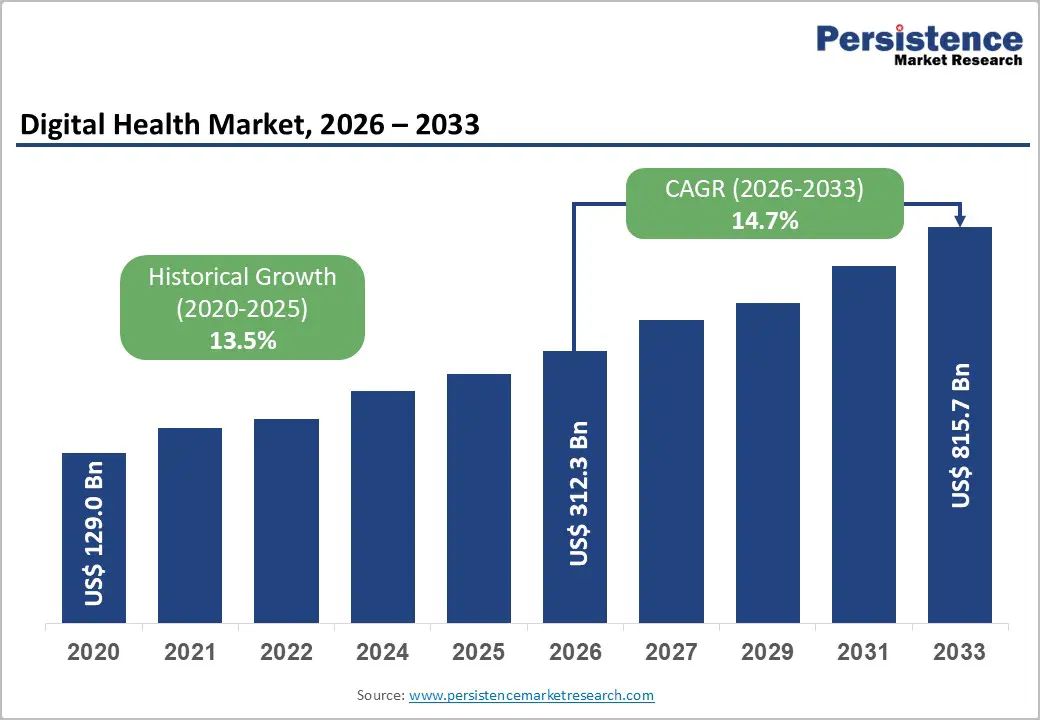
LONDON, UNITED KINGDOM, April 6, 2026 /EINPresswire.com/ -- The global digital health market is projected to expand significantly, with an estimated value rising from US$ 312.3 billion in 2026 to US$ 815.7 billion by 2033. The market is expected to record a compound annual growth rate (CAGR) of 14.7% during the forecast period from 2026 to 2033. This growth is driven by the increasing adoption of telehealth, mobile health (mHealth), and healthcare analytics, coupled with rising investments in software, services, and remote monitoring solutions. North America currently holds the largest market share, while Asia Pacific is emerging as the fastest-growing region due to expanding infrastructure, government initiatives, rising patient awareness, and increasing smartphone penetration.
Download Your Free Sample & Explore Key Insights: https://www.persistencemarketresearch.com/samples/34695
Key Industry Highlights
Dominant Segment
Services account for 57.3% of the digital health market in 2025. The demand for services is driven by hospitals, clinics, and remote care providers seeking support for software deployment, system integration, staff training, maintenance, and managed services. These services ensure seamless operation of telehealth, mHealth, and analytics platforms while maintaining system interoperability, data management, and cybersecurity standards.
Dominant Region
North America leads the global digital health market with a 41.0% share, supported by advanced healthcare infrastructure, high technology adoption, and strong reimbursement frameworks. Asia Pacific is the fastest-growing region due to government initiatives, growing digital health infrastructure, increasing patient awareness, and rapid mobile device adoption.
Market Drivers
Key drivers include the rising prevalence of chronic diseases, growing adoption of telehealth, demand for efficient care delivery, supportive regulatory frameworks, and advancements in AI, cloud computing, and mobile health technologies.
Market Opportunities
Opportunities exist in AI-enabled diagnostics, cloud-based platforms, wearable health devices, predictive analytics, personalized care solutions, remote monitoring, and expansion into emerging economies where improved healthcare access is increasing adoption.
Market Dynamics
Driver: Increasing Adoption of Telehealth and Remote Patient Monitoring
Telehealth and remote patient monitoring are major growth drivers, as virtual care becomes central to modern healthcare delivery. According to the U.S. Centers for Disease Control and Prevention (CDC), telemedicine use among physicians rose from 43% before the COVID-19 pandemic to 88% during the pandemic. Telehealth visits among Medicare beneficiaries surged from approximately 5 million to over 53% early in the pandemic, with more than 80% of physicians planning to continue virtual care. Mobile health tools further support patient engagement, enabling chronic disease management and improved communication between patients and providers. Remote monitoring devices and apps have become integral in clinical care, ensuring continuity for chronic disease follow-ups and routine monitoring.
Restraints: Data Privacy and Cybersecurity Concerns
Data breaches and cybersecurity risks remain significant challenges. In 2024, over 700 healthcare data breaches were reported in the U.S., affecting more than 180 million patient records. Hacking incidents, ransomware attacks, and IT vulnerabilities compromise sensitive information and disrupt hospital operations, delaying procedures and increasing clinical risks. Surveys show that 93% of U.S. healthcare organizations experienced at least one cyberattack in the past year, with 72% reporting patient care disruptions. These security challenges limit the full-scale adoption of digital health solutions.
Get Custom Insights Designed for Your Businecss: https://www.persistencemarketresearch.com/request-customization/34695
Opportunity: Mobile Health Apps, Wearable Devices, and Patient Engagement Tools
The rapid growth of mobile health apps and wearable devices presents opportunities for enhanced patient engagement. Approximately 43% of U.S. adults used a health app in 2024, while globally, over 350,000 digital health apps are available. Wearable device adoption increased from 28% in 2019 to over 36% in 2022, with users willing to share data with providers. Continuous health monitoring through connected apps and wearables enables proactive care, improving health outcomes and expanding market adoption.
Regional Insights
North America
North America leads with a 41.0% market share due to advanced infrastructure, technology adoption, and supportive policies. Over 96% of U.S. hospitals have implemented EHR systems, facilitating interoperability. Telehealth visits increased over 50-fold during the pandemic, supported by regulatory flexibility and reimbursement frameworks from agencies such as CMS.
Europe
Europe maintains strong digital health adoption due to advanced infrastructure, government support, and policy frameworks. The EU-27 average eHealth maturity score reached 83% in 2024, with 85% of member states providing online access to health data. Initiatives like the European Health Data Space enhance cross-border data exchange and innovation.
Asia Pacific
Asia Pacific is the fastest-growing region, benefiting from rising internet and smartphone penetration. Over 1.4 billion people are projected to use digital health tools by 2025, and telehealth usage is expected to exceed 200 million users annually. Rising adoption of mHealth and wearable devices drives growth, particularly in emerging economies.
Checkout Now & Download Complete Market Report: https://www.persistencemarketresearch.com/checkout/34695
Market Segmentation
By Component
Hardware
Software
Services
By Technology
Digital Health Systems
mHealth
Tele-healthcare
Healthcare Analytics
Others
By Application
Chronic Disease Management
Health & Fitness
Behavioral Health
Others
By End-user
Payers
Providers
Patients
Others
By Region
North America
Europe
East Asia
South Asia & Oceania
Latin America
Middle East and Africa
Market Competitive Landscape
Leading companies focus on software, services, and connected devices, prioritizing interoperability, security, and usability. Investments target AI-enabled analytics, telehealth platforms, and patient engagement tools. Key players include Koninklijke Philips N.V., GE Healthcare, Abbott, Teladoc Health, Inc., Siemens Healthineers AG, Masimo, AT & T, Inc., Medtronic, Dexcom, Inc., iHealth Labs Inc., Qardio, Inc., and AdvancedMD, Inc.
Key Industry Developments
Philips introduced AI-driven imaging systems and radiation-free navigation technologies in 2025, enhancing workflow efficiency and patient safety. GE Healthcare launched next-generation Signa MRI systems, featuring advanced imaging, faster scans, and improved patient comfort, emphasizing digital health integration for better clinical outcomes.
The global digital health market is poised for robust growth, driven by telehealth adoption, mobile technologies, AI-enabled platforms, and wearable devices, with emerging regions offering significant opportunities for expansion.
Read Related Reports:
Progressive Multifocal Leukoencephalopathy Treatment Market: The global progressive multifocal leukoencephalopathy treatment market is projected to grow from US$1.4 billion in 2026 to US$1.7 billion by 2033, at a CAGR of 2.8%.
Glycobiology Market: The global glycobiology market to grow from US$2.3 Bn in 2026 to US$6.3 Bn by 2033, registering a strong 15.5% CAGR during 2026–2033.
Persistence Market Research
Persistence Market Research Pvt Ltd
+1 646-878-6329
email us here
Visit us on social media:
LinkedIn
Instagram
Facebook
YouTube
X
Legal Disclaimer:
EIN Presswire provides this news content "as is" without warranty of any kind. We do not accept any responsibility or liability for the accuracy, content, images, videos, licenses, completeness, legality, or reliability of the information contained in this article. If you have any complaints or copyright issues related to this article, kindly contact the author above.
